[A
couple of folks have mentioned that they
are using images from the Field Notes as their desktop image. I think
that's great! One of my daughters, (who is on the list too) asked me
recently for a horizontal version of one of the images to fit her
desktop better. I often shoot in both vertical and horizontal formats
or can crop a vertical image to make it horizontal, so if you want a
horizontal version of an image contact me.]
This week I worked with a wide spectrum of lighting. Three days in a
row this week I made images that have radically different use of
contrast.
The first two images here have vastly different tonality. Often a
photographer working in color tries to control the tonality in an image
to keep it in a fairly narrow range. Recording an image with a camera
is a lot more limiting than what you can see with your eyes. We are
able to see a really vast range of light between what we perceive to be
black and what we perceive to be white. Not so with a camera. Color
film, color slides, black and white film and digital captures all have
a different range of light that they record between white and black,
but in all cases the range is a lot smaller than what we can see with
our own eyes. One way to think of this is that we can see a lot more
details in shadows than the camera can.
The limited tonal range can be a problem. Photographers seldom work in
the middle of the day because the light range is wider than what they
can capture with the camera. Sometimes I talk about the light getting
too "harsh" to shoot. By that I mean there is too many light and dark
areas for the camera to record the way that I see them, which usually
means there would be too many parts of the image that would come out
dark without enough detail. Most of my work is done in the first and
last hours of the day, when there are not dark shadows from overhead
lighting and the light is softer, with a warmer color tint. I also use
two types of filters to help control contrast in my images. The first
is a Polarizer filter to remove glare and reflected light in a scene,
which leads to more saturated colors and less of a washed out feel to
an image. The second filter I use is a Neutral Density filter. It is a
filter that gradually changes from clear on the bottom to gray on the
top, it is used most often to darken part of the scene that
is in
direct light without effecting part of the scene in shadow. This brings
the tonal range between light and dark areas closer together so there
is less contrast and more color recorded.
Sometimes though contrast is good, it adds drama to an image. The next
two images have high contrast for a reason...
In the image above I let the contrast in the image get a lot larger
than I normally would so that the shaft of light would show up. I set
the exposure on the camera to record the leaves correctly and let the
areas of the sky got to white. These shafts of light are called God
Rays... and what can you say, they are a gift from above! :-)
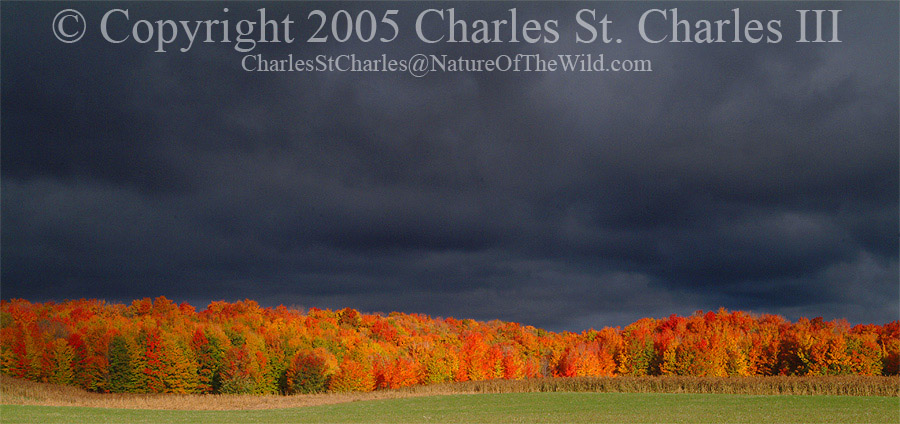
One day later I made a very different use of contrast, here the sky is
almost black. I was driving right after a storm and I noticed a shaft
of sunlight breaking through the clouds, like a spot light. I looked at
the clouds and how the light was moving, found a scene I liked, drove
down a gravel country road north of Buckley, pulled off and I waited.
Almost a half an hour later everything came together. The clouds opened
up just enough for the sun to get through a slit and light up the woods
that I was staking out. I used a very long lens to isolate the light
spot and exposed for the area that was directly lit. Because there was
so much contrast between the trees and the sky the clouds recorded very
dark. Normally this would be an underexposed image, but because I
wanted the drama of a clearing storm it worked great. By the way, in an
image like this it is very important to control the exposure for the
light area, if I had used the sky to determine my exposure then all the
rest of the image would have been washed out.
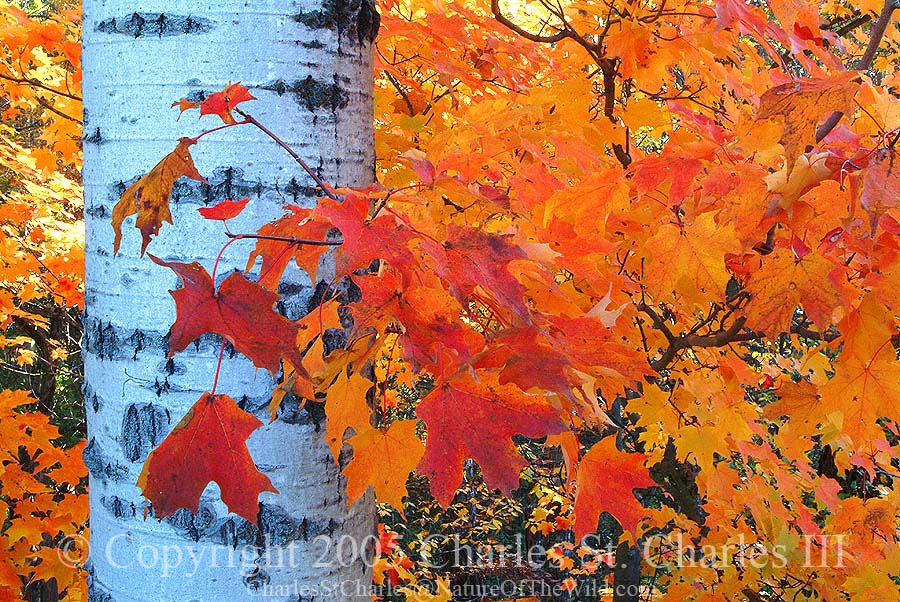
The next day I had another use of contrast. This time instead of tonal
contrast I used color contrast. Without the almost white bark of the
poplar tree this would be a very boring image. I think this a really
important key to fall photography... A red or orange leaf is beautiful,
but filling the photo with the same color does not work real well. It's
like people, it is the contrast between us that make us interesting.
When I can, I use either color contrast or gradation in fall colors to
make the image interesting.
Charles St. Charles III
If you'd prefer not to
receive these field notes or
newsletters just drop me a line. If you know someone else that would
like to receive the field notes or newsletters either have them email
me, or send their email address to me.